Quick Links
Hungary's MNB Opens Insider Trading Probe Into MOL Share Transactions
Key Takeaways
- •The MNB has formally launched an investigation into MOL share transactions, examining potential insider trading tied to the Druzhba pipeline shutdown disclosure timeline.
- •MOL denies wrongdoing, but the probe creates an unresolved governance overhang that typically compresses valuation multiples until resolved.
- •Escalation to criminal prosecutors or executive sanctions would be a materially negative second catalyst; a clean MNB closure could trigger a relief rally.
- •MOL is a major BUX component — sustained repricing affects Hungarian equity indices and, at the margin, HUF-denominated asset risk premia.
- •This event sits within a broader CEE and global regulatory enforcement trend, potentially prompting reassessment of disclosure-risk premia across regional energy peers.
As reported by Reuters, the National Bank of Hungary (Magyar Nemzeti Bank, MNB) — acting in its capacity as financial markets supervisor — has formally launched an investigation into certain transacti
Event Analysis
As reported by Reuters, the National Bank of Hungary (Magyar Nemzeti Bank, MNB) — acting in its capacity as financial markets supervisor — has formally launched an investigation into certain transactions involving shares of MOL Nyrt. (MOL Group), Hungary's flagship oil and gas company listed on the Budapest Stock Exchange. The probe was triggered by allegations from Tebész, Hungary's minority shareholders' association, which claimed MOL may have failed to promptly disclose the shutdown of the Druzhba oil pipeline in Ukraine, while senior executives simultaneously sold MOL shares worth billions of forints — a pattern that raises the specter of insider trading under EU market abuse rules.
MOL has publicly maintained that both its market disclosures and executive share transactions fully complied with applicable regulations. The MNB has not disclosed specific names, transaction volumes, or dates, citing the ongoing nature of the investigation. This ambiguity is itself a market variable: the range of outcomes spans from a clean bill of health to material sanctions, forced executive departures, or even criminal referral — each carrying a very different repricing implication for MOL equity.
This event fits squarely within the broader global regulatory enforcement wave that has seen market supervisors across jurisdictions sharpen their scrutiny of corporate disclosure practices, particularly around material operational events. For Hungary specifically, the MNB's willingness to investigate a systemically important company like MOL signals either strengthening institutional oversight — or, depending on how the process unfolds, could feed into a narrative around cross-border enforcement repricing of governance risk in Central and Eastern European equity markets. MOL is not a peripheral name; it is a major BUX index component and a key player in regional energy infrastructure.
What This Means for Traders
The immediate market impact is a negative sentiment overhang on MOL equity. Regulatory probes into insider trading and disclosure failures — even unresolved ones — typically widen idiosyncratic risk premia: price-to-earnings multiples compress, short interest can build, and institutional investors may reduce exposure pending clarity. The key binary outcomes to monitor are whether this remains an administrative MNB proceeding or escalates to criminal prosecutors, and whether any executives face sanctions or are forced to step down. Either escalation would represent a material second leg lower for the stock; a clean closure would likely provide a sharp relief bounce.
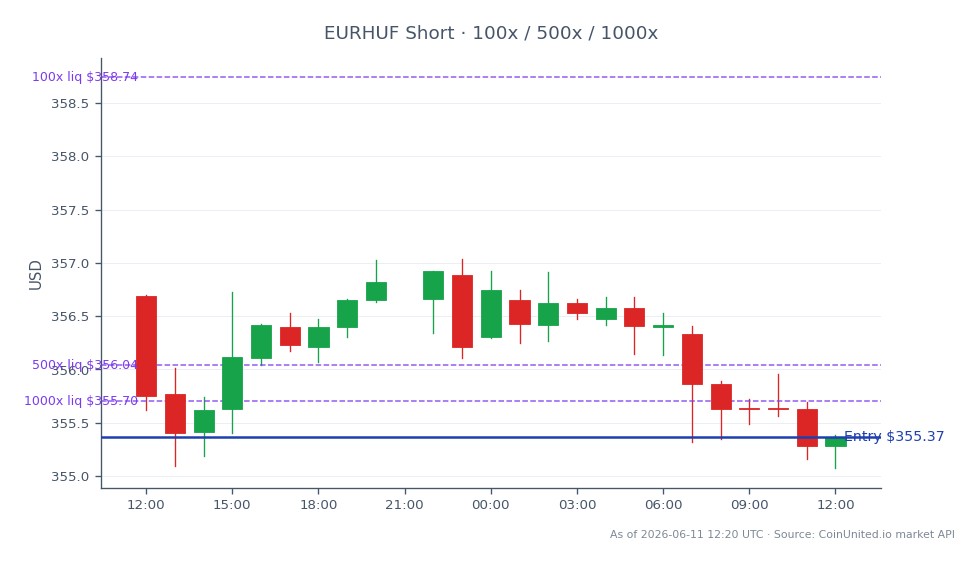
For index and cross-market traders, MOL's weight in the BUX and in CEE equity baskets means sustained repricing transmits to the Euro / Hungarian Forint and to broader Hungarian asset risk premia — though on its own, a single corporate probe is unlikely to be a dominant HUF driver. Traders positioning in the Hungarian index via CFDs should monitor MNB newsflow closely. The investigation's energy-sector context (Druzhba pipeline) is a governance and disclosure story rather than a physical supply disruption, so global oil benchmarks are not directly affected.
CoinUnited's MOL stock CFD and HUNIDX index CFD trade 24/7 — meaning any after-hours MNB statement or overnight regulatory update can be acted on immediately without waiting for the Budapest session open.
Start Trading on CoinUnited.io
Create Your Free Account → — Trade crypto, stocks, forex, indices, and commodities with up to 2000x leverage and zero fees.
Frequently Asked Questions
Tebész alleges MOL failed to disclose the Druzhba oil pipeline shutdown in a timely manner, and that senior executives sold shares worth billions of forints while potentially holding non-public, price-sensitive information — the definition of insider trading under EU market abuse rules.
Continue Exploring
Disclaimer: This brief is for educational purposes only and is not investment advice.