Quick Links
Dollar Steadies After US Strikes on Iran: Leverage Scenarios Across FX, Oil, and Crypto
Key Takeaways
- •Dollar safe-haven bid is structural near-term: both geopolitical risk and sticky inflation data risk support USD, pressuring leveraged long EUR/USD and EM FX CFDs.
- •Oil risk premium of $5–$10/bbl is the baseline for a limited strike; Hormuz escalation drives a far larger repricing toward $90–$100/bbl — position sizing must reflect this binary.
- •Leverage traders face a dual-catalyst liquidation window: geopolitical headlines AND inflation data within the same session; reduce size or widen stops accordingly.
- •Crypto faces macro headwinds (strong dollar + elevated real rates) but may partially decouple via digital-gold narrative if inflation overshoots dramatically — monitor BTC funding rates.
- •Cross-market: European equities and energy-importing EM FX are the most exposed to a sustained oil shock; defense and energy sector CFDs are the structural longs in an escalation scenario.
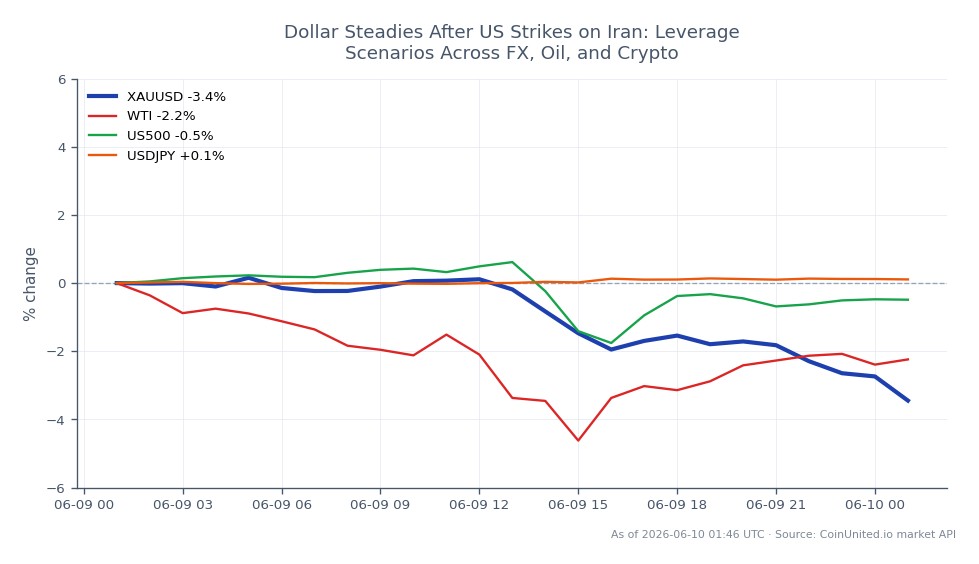
According to Bloomberg, the US dollar strengthened versus the euro and most major FX peers in Asia trading following US strikes on Iranian targets, with crude oil futures climbing and US equity future
Event Summary
According to Bloomberg, the US dollar strengthened versus the euro and most major FX peers in Asia trading following US strikes on Iranian targets, with crude oil futures climbing and US equity futures slipping as markets repriced geopolitical and energy-supply risk. The dollar has since steadied as traders balance the initial safe-haven bid against upcoming US inflation data — a combination that sits squarely at the Fed Macro Policy Crossroads and feeds directly into the Macro Inflation Risk-Off Repricing theme.
The key unresolved question is whether the strikes remain a contained, limited event or escalate toward the Strait of Hormuz. Research indicates a limited-strike scenario adds a headline risk premium of approximately $5–$10/bbl to crude without actual supply disruption, while a Hormuz escalation could drive Brent toward the $90–$100/bbl range or higher, as detailed in the US-Iran War & Oil Markets Trader's Guide.
Leverage Impact Analysis
This is a high-volatility, dual-catalyst setup — geopolitics *and* inflation data — which creates acute liquidation risk for leveraged positions on both sides.
Forex leverage scenarios: A trader holding a 100x long EUR/USD CFD at 1.0850 faces roughly a 1% adverse move (to ~1.0742) before a full margin wipe at 100x. With the dollar bid on safe-haven flows, EUR/USD is structurally pressured. Inflation data landing hot would compound USD strength and accelerate this scenario.
Oil leverage scenarios: A 50x long WTI CFD benefits from the initial $5–$10/bbl spike, but risk is asymmetric — if the strikes are confirmed as limited with intact Hormuz flows, mean-reversion can be rapid and violent, liquidating late-entry longs within hours. Monitor whether WTI holds the post-spike level as a containment signal.
USD/JPY cross-current: The USD/JPY pair presents a conflicted setup — both USD (geopolitical safe-haven) and JPY (classic risk-off haven) attract bids simultaneously. High-leverage positions should size down given the directional ambiguity; check live funding rates on CoinUnited.io before entering.
Cross-Market Impact
The Oil Shock & Geopolitical Risk-Off theme cascades across all five markets. Gold strengthens as a safe-haven alongside the dollar — historically these move together in US–Iran episodes, though the gold vs. US dollar inverse relationship can diverge if the dollar dominates. European and EM equities underperform US peers due to higher energy import exposure, weighing on the S&P 500 less severely than regional peers.
Crypto trades as a high-beta risk asset in this setup. A strong dollar plus sticky inflation expectations — the stagflation risk scenario — creates headwinds for Bitcoin and altcoins via the rate-expectations channel. However, if inflation data overshoots and forces a hawkish Fed re-pricing, Bitcoin may partially decouple via the digital-gold narrative. Monitor BTC perpetual funding rates for crowding signals.
Airlines and transport CFDs (e.g., United Airlines) face direct margin compression from elevated fuel costs — see the sector breakdown in our Middle East Conflict & Inflation Trader's Guide.
Trading Considerations
The immediate priority is determining containment: intact Hormuz flows = transient oil spike that fades, supporting a partial risk-on recovery. Escalation = sustained energy-inflation shock that keeps the dollar bid and pressures equities and crypto. The upcoming inflation print is the second catalyst — a hot reading compounds the dollar-positive, risk-negative setup, while a soft reading could trigger sharp relief rallies across risk assets.
Key levels to watch: WTI holding post-strike gains (containment failure signal on a breakdown), EUR/USD regaining 1.0850 (dollar fatigue signal), and BTC perpetual funding rates flipping negative (crowded short signal). For CPI data trading strategy, reduce position size ahead of the print given compounded volatility from the geopolitical overlay.
Start Trading on CoinUnited.io
Create Your Free Account → — Trade crypto, stocks, forex, indices, and commodities with up to 2000x leverage and zero fees.
Frequently Asked Questions
At 100x leverage on a EUR/USD long at 1.0850, a 1% move lower (to approximately 1.0742) eliminates the entire margin — and safe-haven dollar demand combined with a potential hot inflation print makes that move plausible within a single session. Reduce size or use wider stops until the inflation data is cleared.
Continue Exploring
Disclaimer: This brief is for educational purposes only and is not investment advice.