Quick Links
SpaceX Locks $135 IPO Price: What a $1.75 Trillion Mega-Listing Means for Markets
Data Snapshot
Key Takeaways
- •SpaceX's fixed-price IPO structure (no range) signals unusually strong investor demand — a rare move indicating the syndicate sees pricing risk as negligible.
- •At ~$1.75T fully diluted valuation and <5% float, extreme supply-demand imbalance on listing day makes elevated volatility and day-one price spikes structurally probable.
- •$75B in primary proceeds arms SpaceX to aggressively compete in launch pricing, satellite capacity, and AI infrastructure — a direct competitive threat to listed peers like RKLB and VSAT.
- •Eventual index inclusion would force passive funds to sell existing constituents, creating structured rebalancing pressure across S&P 500 and NASDAQ-100 heavyweights.
- •A successful close reinforces the broader IPO revival narrative, potentially accelerating listing timelines for other large private tech names currently watching from the sidelines.
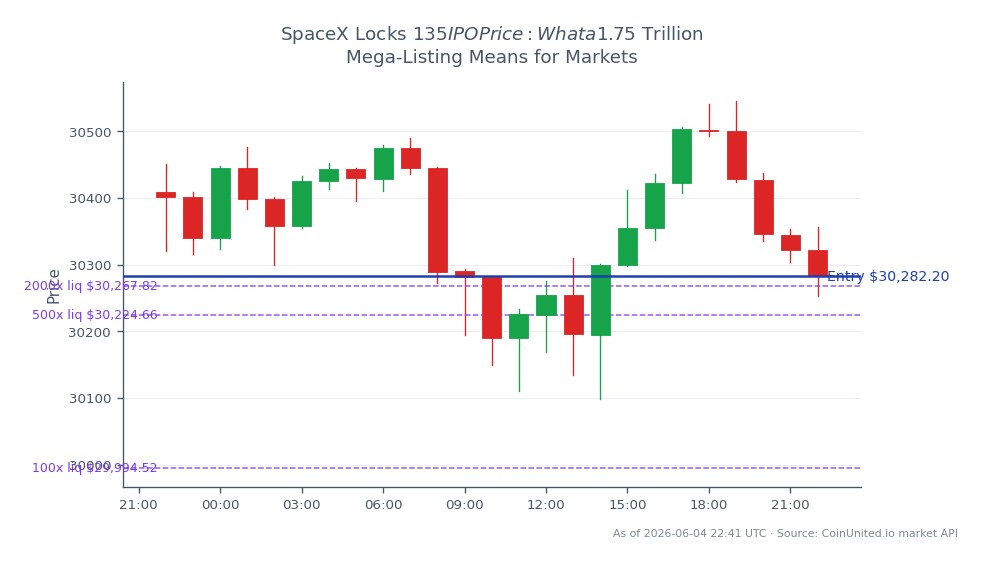
As reported by Reuters, SpaceX has filed an amended S-1 setting a fixed IPO price of $135 per share — an unconventional move that sidesteps the traditional book-building price range entirely. Accordin
Event Analysis
As reported by Reuters, SpaceX has filed an amended S-1 setting a fixed IPO price of $135 per share — an unconventional move that sidesteps the traditional book-building price range entirely. According to the filing details, SpaceX plans to offer approximately 555.6 million primary shares, implying gross proceeds of roughly $75 billion, all flowing directly to the company with no secondary sellers. At $135/share, the fully diluted valuation lands at approximately $1.7–$1.75 trillion, immediately placing SpaceX among the largest companies on earth from day one of trading.
The fixed-price structure is the real signal here. Book-building with a range is standard practice precisely because it lets underwriters gauge demand and calibrate the final price. Abandoning that convention communicates that SpaceX and its syndicate believe demand is so robust that price discovery is unnecessary — a rare, deliberate projection of pricing power. This is structurally different from past large IPOs (Alibaba, Saudi Aramco) which used traditional ranges. Combined with a float representing less than 5% of total equity value, the setup creates acute supply-demand imbalance on listing day. Traders should expect elevated implied volatility and potential day-one price spikes.
The proceeds size also carries strategic weight. With $75 billion in fresh primary capital, SpaceX dramatically de-risks its Starlink global expansion, Starship development program, and what the company itself frames as AI infrastructure ambitions tied to on-orbit compute and low-latency connectivity. This isn't just a capital raise — it's a competitive moat-widening event that puts smaller launch and satellite broadband peers on the back foot immediately. The IPO Wave & Capital Markets Revival theme gets a significant shot of credibility if this deal closes cleanly, potentially reopening the window for other large late-stage tech names watching from the sidelines.
What This Means for Traders
The most direct pre-listing trading angle sits in the space and satellite peer complex. Rocket Lab USA (RKLB), Viasat (VSAT), Iridium (IRDM), and aerospace majors with space exposure (Lockheed Martin, Northrop Grumman, RTX) all face a dual-edged dynamic: SpaceX's premium valuation could lift peer multiples via sector sentiment, but its $75B war chest signals intensified competition that structurally pressures smaller players. Traders should watch whether the sector trades as a rising tide or bifurcates between SpaceX proxies and incumbents under competitive threat. Tesla (TSLA) also warrants attention — historically sensitive to Musk corporate events, a successful SpaceX IPO arguably strengthens Musk's capital position and reduces perceived governance overhang on Tesla.
For index traders, the longer-term implication is passive flow disruption. At ~$1.75 trillion, SpaceX would be a mega-cap candidate for the S&P 500 Index and NASDAQ 100 subject to profitability and seasoning rules. If and when inclusion occurs, passive funds would need to trim existing constituents to fund buys — creating structured selling pressure across current index heavyweights. The $75B raise also temporarily absorbs significant global growth capital, which could produce short-term weakness in comparable tech names as institutional investors raise cash for allocations. Traders positioned in the 2026 Pre-IPO Market should note this sets a valuation benchmark for other large private tech names still awaiting listing.
Start Trading on CoinUnited.io
Create Your Free Account → — Trade crypto, stocks, forex, indices, and commodities with up to 2000x leverage and zero fees.
Frequently Asked Questions
A fixed price signals the underwriting syndicate is confident enough in demand that they don't need market feedback to set valuation — it projects pricing power and avoids the optics of a downward price revision during bookbuilding.
Continue Exploring
Disclaimer: This brief is for educational purposes only and is not investment advice.