Quick Links
Photronics Q2 Miss: Semiconductor Supply Chain Signal and Leverage Trap for Small-Cap Semi Longs
Data Snapshot
Key Takeaways
- •PLAB entered earnings with longs leaning bullish (+2% pre-print run-up), making the gap-down impact on leveraged long CFD positions disproportionately severe.
- •At 50x leverage, a 15% gap down exceeds available margin — traders must size post-earnings positions at 5x–10x or lower to survive volatility without forced liquidation.
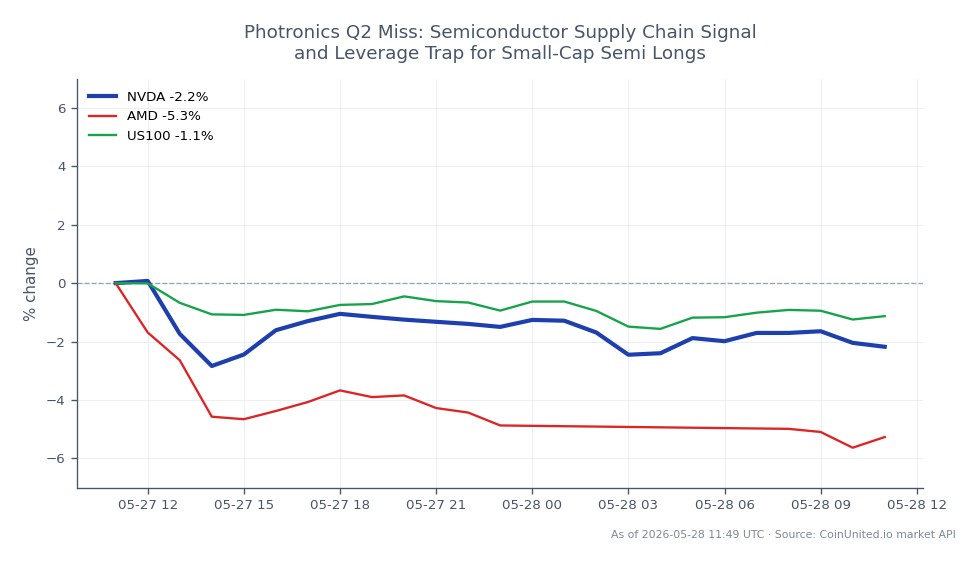
- •The IC photomask miss is a mild negative read-through for NVDA and AMD, but AI-driven tape-out demand likely limits contagion to those large-cap names.
- •Watch conference call commentary on China/Korea order trends and buyback guidance — these two variables determine whether PLAB is a recovery play or a continuation short.
- •NASDAQ 100 exposure is indirect; monitor whether mid-cap semi peers trade sympathetically to assess sector-wide vs. PLAB-specific risk.
Photronics, Inc. (PLAB), a Nasdaq-listed photomask manufacturer and critical node in the semiconductor supply chain, reported fiscal Q2 2026 results on May 28, 2026 before market open. According to Pe
Event Summary
Photronics, Inc. (PLAB), a Nasdaq-listed photomask manufacturer and critical node in the semiconductor supply chain, reported fiscal Q2 2026 results on May 28, 2026 before market open. According to Perplexity Finance data, analyst consensus heading into the print was approximately $0.54 EPS and $216.5M in revenue. The reported results came in weak enough to trigger a sharp sell-off — a classic earnings miss revenue shock scenario for a small/mid-cap cyclical semi name.
Noteworthy pre-print context: PLAB shares had gained over 2% in the days ahead of earnings as investors positioned bullishly into the release, meaning leveraged longs were leaning in the wrong direction when results crossed the wire.
Leverage Impact Analysis
For traders holding leveraged PLAB CFD positions via CoinUnited.io, the post-earnings gap is the primary risk vector. Small/mid-cap stocks like PLAB routinely gap 10–25% on earnings misses, and leverage amplifies this proportionally with no buffer.
Worked example — leveraged long caught in the gap: A trader holding a 50x long PLAB CFD at a pre-earnings entry is exposed to the full percentage move on 1/50th of the notional margin. A 15% gap down wipes 750% of the margin posted — a full liquidation and then some if stop-loss orders don't execute at the intended price during a gap open.
Worked example — post-gap short: A trader initiating a 20x short PLAB CFD *after* the gap open (to express continued downside from guidance cuts or analyst downgrades) carries a more defined risk profile. A subsequent 5% bounce from oversold levels would represent a 100% loss of margin on a 20x position — position sizing must be tight.
For those navigating earnings miss and guidance cut setups, the key discipline is entering post-gap with reduced leverage (5x–10x range), not chasing the initial move at full size. Monitor for analyst estimate revisions in the 24–48 hours following the print, as these often drive a second leg lower in small-cap semi names.
Cross-Market Impact
PLAB is not a macro mover on its own, but its photomask business serves as an early-cycle read on IC tape-out volumes and display capex — making the read-through meaningful for related names.
Semiconductor peers: Weak photomask demand implies fewer new IC designs entering production. This is a mild negative read-through for NVIDIA (NVDA) and AMD if attributed to broader IC softness, though AI-driven tape-outs remain structurally elevated and may insulate those names. The larger risk is to mid-tier logic and display-exposed foundry suppliers.
NASDAQ 100: PLAB is not a direct NASDAQ 100 component, but deteriorating guidance from semis supply-chain names adds incremental pressure to the semis weighting within the index. Watch whether other small/mid-cap semi names trade sympathetically lower — that pattern would signal broader sector rotation risk rather than a PLAB-idiosyncratic event.
FX and commodities: No material direct impact. Marginal KRW and TWD sentiment pressure if weakness is attributed to softening Korean/Chinese display orders, but this is a second-order effect.
Trading Considerations
The critical variable to assess is *why* Q2 was weak: backward-looking utilization dip (mean-reversion candidate) versus forward guidance cut signaling multi-quarter demand deterioration (continuation short). Traders should review the conference call transcript for commentary on China/Korea order trends, capacity utilization rates, and any capex pullback signals before sizing into positions.
For earnings miss recovery play frameworks, PLAB's historical pattern of using buybacks as equity support is a factor — if FCF remains intact and management reaffirms the buyback, the flush may be a setup rather than a structural breakdown. Key risk: any reduction in buyback guidance removes a key price floor.
Start Trading on CoinUnited.io
Create Your Free Account → — Trade crypto, stocks, forex, indices, and commodities with up to 2000x leverage and zero fees.
Frequently Asked Questions
A 15% gap on a 50x long CFD translates to a 750% margin loss — well beyond available collateral, triggering liquidation before stops can execute at intended levels. Reduce leverage to 5x–10x on any post-gap entries.
Continue Exploring
Disclaimer: This brief is for educational purposes only and is not investment advice.