Quick Links
Asia Calendar 27 May 2026: BoJ SPPI, Aussie CPI, RBNZ Decision & Fed Tone — Leverage Traders on Watch
Data Snapshot
Key Takeaways
- •BoJ SPPI at 8:50 JST on 27 May is confirmed; no BoJ rate decision is scheduled — next policy meeting is June 14–15.
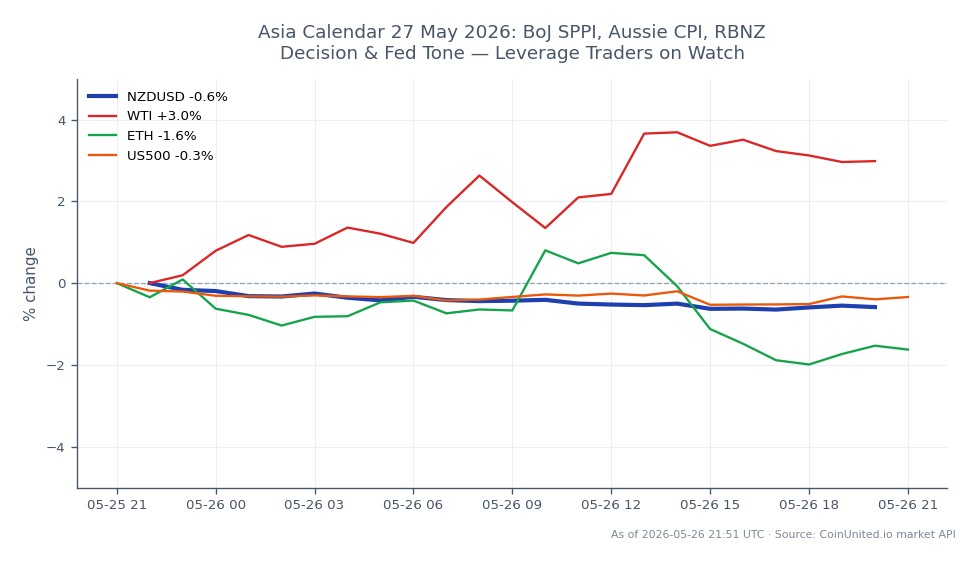
- •NZD/USD is compressed in a $0.5832–$0.5872 range ahead of the RBNZ decision; a 100x leveraged position faces ~60% margin erosion on a 0.6% adverse move.
- •A hawkish sweep across all four events (SPPI beat + CPI beat + hawkish RBNZ + firm Fed) constitutes a coordinated tightening impulse bearish for gold, equities, and crypto.
- •AUD/USD and NZD/USD traders should size down 40–60% versus normal given stacked same-session event risk.
- •CoinUnited's 24/7 forex CFDs allow immediate positioning on Asia-session prints without waiting for traditional market opens.
Asia's macro calendar converges on 27 May 2026 with four overlapping catalysts. The Bank of Japan releases its Services Producer Price Index (SPPI) for April at 8:50 JST — a confirmed BoJ-scheduled da
Event Summary
Asia's macro calendar converges on 27 May 2026 with four overlapping catalysts. The Bank of Japan releases its Services Producer Price Index (SPPI) for April at 8:50 JST — a confirmed BoJ-scheduled data point that feeds directly into policy normalisation expectations. The RBNZ is expected to deliver an Official Cash Rate (OCR) decision, Australia's CPI release is due (date plausible per ABS recurring schedule), and Fed communications continue to shape global rate expectations. Notably, the BoJ has no policy-rate meeting on this date; the next full BoJ meetings are June 14–15 and July 29–30.
According to the BoJ's official release calendar, the SPPI print is one of several inflation-relevant releases in the 26–27 May window. Markets will interpret the combined signal across all four events as either a tightening impulse or a catalyst for macro inflation risk-off repricing.
Leverage Impact Analysis
This calendar cluster creates asymmetric vol risk for leveraged FX positions. Live market data shows NZD/USD trading at $0.5836, with a 24h range of $0.5832–$0.5872 and already down 0.62% — a compressed range that frequently precedes a sharp directional break on binary event outcomes.
NZD/USD leverage scenario: A trader holding a 100x long NZD/USD at $0.5836 controls a notional position 100x the base. A hawkish RBNZ surprise driving a 0.5% rally to ~$0.5865 would generate a ~86% return on margin. Conversely, a dovish hold with soft guidance could push NZD/USD toward the $0.5800 area — a ~0.6% move that wipes ~60% of margin on the same 100x position.
AUD/USD leverage scenario: A CPI upside surprise in Australia would compress RBA cut expectations, likely pushing AUD/USD toward resistance. Traders holding high-leverage AUD longs ahead of the print benefit from swift repricing, but stop placement below nearby support is critical given binary outcome risk.
JPY cross risk: A BoJ SPPI beat reinforces the case for sustained BoJ normalisation, which the APAC stagflation and currency stress theme tracks closely. Short USD/JPY positions at 50x face sharp adverse moves if SPPI disappoints and JPY weakens — monitor the Jun 14–15 BoJ meeting as the next hard catalyst for JPY repricing.
For all three pairs, position sizing down by 40–60% versus normal is warranted given stacked event risk within a single Asia session window.
Cross-Market Impact
The combined tightening impulse scenario — hawkish SPPI, CPI beat, hawkish RBNZ — represents a coordinated APAC hawkish pivot that has historically weighed on global risk assets. The S&P 500 and NASDAQ 100 face pressure if higher APAC real yields spill into US duration trades; growth and tech valuations are most sensitive.
Gold faces a headwind in the hawkish scenario — stronger USD and rising real yields reduce the inflation-hedge appeal. WTI crude is indirectly affected via global demand expectations; a tighter APAC policy mix marginally dampens the growth demand channel. Bitcoin and Ethereum increasingly behave as high-beta macro assets: a hawkish Fed tone layered on top of APAC tightening raises global real yields and strengthens USD — historically a negative liquidity signal for crypto. Refer to our Fed macro policy crossroads theme for the broader USD-risk-asset dynamic.
Trading Considerations
NZD/USD is range-bound between $0.5832 support and $0.5872 resistance heading into the RBNZ print — a break of either level on above-average volume would confirm directional momentum. Given the prior RBNZ hold at 2.25% with a hawkish majority (per prior coverage), the market's base case leans toward a hold with guidance; any explicit hike or aggressive forward language would be the surprise. For AUD/USD and JPY crosses, watch whether the collective prints lean toward a unified macro inflation pressure tightening signal or a split outcome — the latter produces cross-volatility in AUD/NZD rather than clean directional moves. CoinUnited's 24/7 forex trading means traders can act on these Asia-session prints without waiting for a traditional session open.
Trade New Zealand Dollar / US Dollar on CoinUnited.io
Trade NZDUSD with up to 2000xx leverage → | Create Free Account
Frequently Asked Questions
With NZD/USD at $0.5836 in a tight $0.5832–$0.5872 range, a hawkish surprise could push toward $0.5900+, yielding large gains for leveraged longs, while dovish guidance risks a break below $0.5832 support — a 100x position would see margin erosion exceed 60% on a 0.6% adverse move.
Continue Exploring
Disclaimer: This brief is for educational purposes only and is not investment advice.