Quick Links
Fed 'Higher for Longer' Repricing: How Vanishing 2026 Cut Bets Reshape Forex, Crypto, and Rates
Data Snapshot
Key Takeaways
- •Fed rate cut expectations have shifted from 1–2 cuts in 2026 to no cuts until mid/late 2027, per BofA Private Bank — a 6–12 month repricing with direct USD implications.
- •Leverage risk is elevated: at 200x on EUR/USD, a 25-pip adverse move can hit liquidation — strict position sizing below 1–2% account risk per trade is essential.
- •Policy divergence (Fed on hold, BoE cutting) creates a structural headwind for GBP/USD and supports USD across AUD, NZD, and JPY pairs.
- •Crypto faces a macro headwind as delayed easing removes the liquidity tailwind — Bitcoin and ETH bulls must rely on structural narratives, not Fed pivot expectations.
- •Rising 2-year Treasury yields (+10 bps) signal front-end repricing; watch this level as the primary macro signal for USD direction across leveraged forex positions.
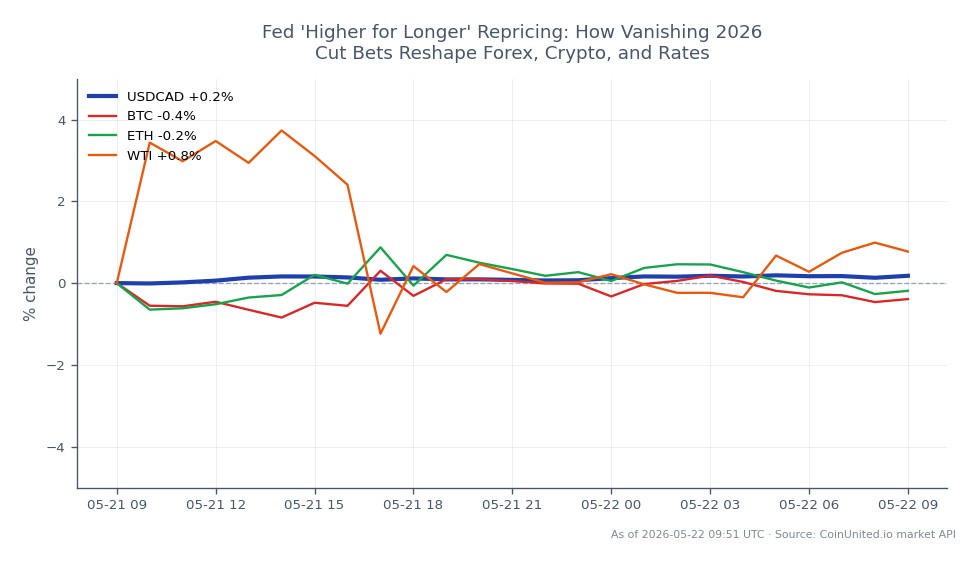
According to U.S. Bank, the Federal Reserve held the federal funds rate at 3.50–3.75% at its April 2026 meeting, with internal dissent over statement language signaling hawkish friction. Markets have
Event Summary
According to U.S. Bank, the Federal Reserve held the federal funds rate at 3.50–3.75% at its April 2026 meeting, with internal dissent over statement language signaling hawkish friction. Markets have now sharply repriced the path forward: where consensus once anticipated 1–2 cuts in 2026, Bank of America Private Bank now sees no cuts until mid/late 2027 — a roughly 6–12 month pushback in easing expectations.
The immediate market reaction was unambiguous: the 2-year Treasury yield rose +10 bps and the 10-year +8 bps, per U.S. Bank. CME FedWatch probabilities have moved in lockstep, pricing out near-term cuts. Separately, the Bank of England holds its rate at 3.75% (next decision 30 April 2026) and is still expected to deliver 1–2 gradual cuts by year-end — creating a meaningful Fed/BoE policy divergence that directly impacts GBP/USD and EUR/USD.
This repricing reflects persistent inflation uncertainty, FOMC dissent, and incoming Fed leadership (Kevin Warsh expected to replace Powell), all of which the Fed Macro Policy Crossroads theme has been tracking.
Leverage Impact Analysis
This is a high-leverage event. When policy path expectations shift by 6–12 months, pip moves on major forex pairs can be swift and asymmetric — and leveraged positions feel every basis point.
USD/CAD Example: With USD/CAD currently trading at $1.38 (per live data), a trader long USD/CAD at 100x leverage controls ~$138,000 notional per standard lot. A 50-pip adverse move (0.0050) generates a $500 loss on that notional — roughly a 36% drawdown on a $1,380 margin deposit. At 500x, the same move hits margin in under 10 pips.
EUR/USD Short Setup: A hawkish Fed vs. dovish ECB divergence supports EUR/USD shorts. A trader short EUR/USD at 200x with a 1.0850 entry faces liquidation if EUR/USD rallies ~25 pips without a stop — equivalent to less than one session's range on a normal macro day. Position sizing below 1–2% account risk per trade is critical here.
JPY Pairs: USD/JPY remains structurally supported by the rate differential — but BoJ intervention risk is the wildcard. Monitor funding rates and check open interest on CoinUnited.io for confirmation before sizing into high-leverage yen longs. For a full framework see the Japanese Yen Intervention guide.
For deeper context on how Fed decisions transmit to leverage trades across all markets, the Fed Rate Decisions & Markets guide is essential reading.
Cross-Market Impact
Forex: USD gains a structural tailwind. BoE cutting while the Fed holds creates a negative rate-differential drag on GBP/USD. AUD/USD and NZD/USD face headwinds as risk appetite softens and the dollar stays bid — see our AUD/USD Trading Guide for key levels.
Equities: Higher-for-longer compresses multiples on long-duration growth stocks (Nasdaq-heavy tech). The NASDAQ 100 faces P/E ceiling pressure. Financials may benefit from net interest margin expansion, but rising credit risk is the offset.
Crypto: Delayed easing is a macro headwind for Bitcoin and Ethereum. Bull cases increasingly rely on structural/adoption narratives rather than liquidity tailwinds. High-beta altcoins are most exposed — the oil geopolitical risk-off theme compounds this if energy-driven inflation keeps the Fed on hold longer.
Gold/Commodities: Rising real yields are a near-term headwind for gold, but persistent inflation supports it as a hedge. The tension between these two forces means gold trades in a contested range — see Gold vs. US Dollar for the framework. Elevated oil prices reinforce the inflation-persistence narrative per Bankrate's commentary, sustaining higher-for-longer conditions. The macro inflation risk-off repricing theme connects all these threads.
Trading Considerations
The key watch points are: (1) any FOMC communication shift around the Fed leadership transition to Kevin Warsh — markets will re-price aggressively on any dovish signal; (2) BoE's 30 April 2026 decision for GBP/USD direction; (3) 2-year Treasury yield — if it breaks decisively above recent highs, expect further USD strength across majors. For a comprehensive macro inflation trading strategy, position sizing discipline at elevated leverage is the primary risk control.
For a broader macro lens across all currency pairs in this environment, the 2026 Forex Market Outlook provides the full rates-divergence framework.
Trade US Dollar / Canadian Dollar on CoinUnited.io
Trade USDCAD with up to 2000xx leverage → | Create Free Account
Frequently Asked Questions
The rate differential between the Fed (on hold) and BoJ remains wide, structurally supporting USD/JPY longs — but Japanese government intervention risk creates sudden 100–200 pip reversal events that can liquidate positions above 100x leverage in seconds. Keep stops wide enough to survive intervention spikes or size down significantly.
Continue Exploring
Disclaimer: This brief is for educational purposes only and is not investment advice.