Quick Links
Vivendi Shares Slide as France's Top Court Strips Buyout Premium — Bollore Control Finding Overturned
Key Takeaways
- •France's Cour de Cassation overturned the finding that Vincent Bolloré exercises de facto control over Vivendi SE, removing the immediate legal obligation for a multibillion-euro mandatory buyout offer.
- •Vivendi shares face downside pressure as the buyout premium — which had driven a reported 13%+ rally on the prior Court of Appeal ruling — deflates; retrial outcome remains the next binary catalyst.
- •Bolloré SE is the beneficiary: avoiding a forced bid materially improves its capital flexibility and removes a large-scale funding overhang.
- •The ruling sets a precedent limiting AMF's ability to infer de facto control from qualitative factors like personal reputation, reducing forced-bid risk premia in other French companies with complex shareholder structures.
- •Event-driven and merger-arb strategies in European equities should re-model control-premium probabilities across French-listed names with sub-30% but near-threshold ownership structures.
France's Cour de Cassation (supreme civil court) ruled on November 28, 2025 to overturn the Paris Court of Appeal's April 2025 decision that Vincent Bolloré exercised *de facto* control over Vivendi S
Event Analysis
France's Cour de Cassation (supreme civil court) ruled on November 28, 2025 to overturn the Paris Court of Appeal's April 2025 decision that Vincent Bolloré exercised *de facto* control over Vivendi SE. As reported by Reuters, the court found that control cannot be inferred from qualitative factors — such as a shareholder's personal reputation or perceived authority at meetings — and sent the case back to a differently composed appeals court for retrial. The Autorité des marchés financiers (AMF), France's markets regulator, has formally acknowledged the ruling's impact on its own prior determination that Bolloré was obliged to file a public withdrawal offer for Vivendi minorities.
The stakes are enormous: Bolloré SE directly holds approximately 29.9% of Vivendi. The earlier rulings had treated Vivendi's treasury shares as effectively under Bolloré influence, pushing effective control above the 30% threshold that triggers a mandatory takeover offer under French law. Analysts at JPMorgan had estimated the forced buyout — covering roughly 70% of Vivendi's float — could run to several billion euros. That premium had been priced into Vivendi shares, with the stock reportedly surging over 13% when the Court of Appeal initially confirmed the control finding.
This ruling is a meaningful precedent for French takeover law. The Cour de Cassation has clarified that *de facto* control determinations must rest on more than soft influence, narrowing the AMF's ability to impose costly mandatory bids based on qualitative factors alone. The case now moves to retrial, keeping uncertainty alive — but the immediate legal compulsion for a multibillion-euro buyout has been removed. This is a clear example of a regulatory final ruling acting as a market catalyst.
What This Means for Traders
For Vivendi shareholders, the ruling eliminates — or at minimum, substantially delays — the buyout premium that had supported the stock. Vivendi must now be valued on standalone operational fundamentals and probability-weighted retrial outcomes rather than near-certain take-out optionality. The directional implication is bearish near-term, as event-driven and merger-arb traders who had positioned for a forced offer unwind those bets. Monitor the retrial timeline closely: any new evidence that could re-establish a control finding would swing sentiment back sharply.
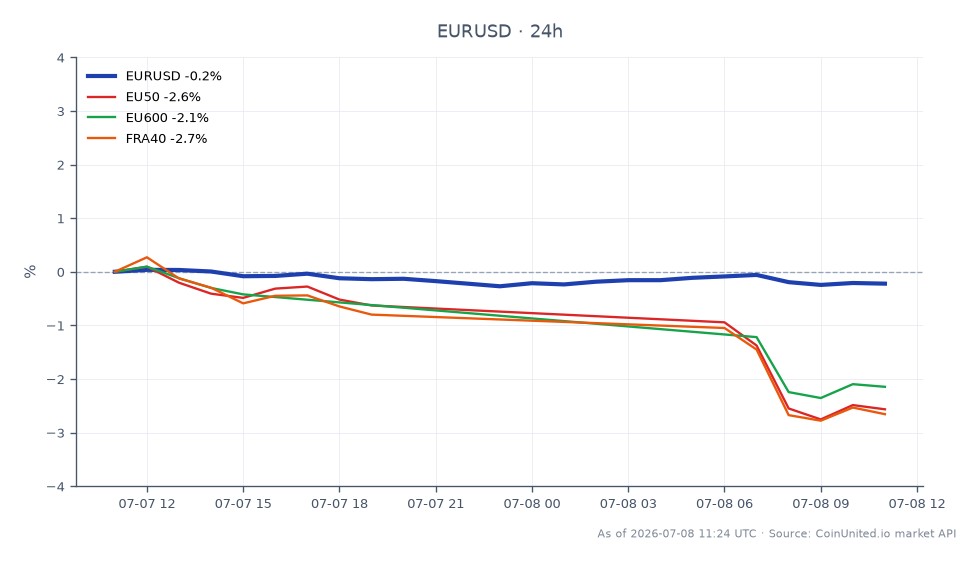
Bolloré SE is the mirror trade — the removal of a potential multibillion-euro mandatory outlay materially improves the family holding company's capital flexibility and balance sheet risk profile. For traders in CAC 40 or EURO STOXX 50 instruments, Vivendi's index weight means a sharp single-stock move transmits into French and European equity benchmarks at a noticeable but non-systemic level. The STOXX Europe 600 impact is further diluted. Volatility in Vivendi CFDs is likely to remain elevated through the retrial process.
The broader read-across is for M&A and acquisition-driven positioning in French-listed companies with complex ownership structures. The ruling tightens the link between formal voting rights and legal control, reducing the probability that courts impose forced bids on qualitative grounds — a structural shift that lowers the *de facto* control risk premium embedded across similar French names.
Start Trading on CoinUnited.io
Create Your Free Account → — Trade crypto, stocks, forex, indices, and commodities with up to 2000x leverage and zero fees.
Frequently Asked Questions
The April 2025 Court of Appeal ruling found Bolloré controlled Vivendi, implying a mandatory buyout offer at a premium — markets priced in that exit. The Cour de Cassation has now struck down that finding, so the buyout premium evaporates.
Continue Exploring
Disclaimer: This brief is for educational purposes only and is not investment advice.