Quick Links
Canary HBAR ETF Embeds Staking Rewards in Trust Docs — Sponsor Captures Yield, Not Shareholders
Data Snapshot
Key Takeaways
- •Canary Capital's amended Sponsor Agreement explicitly entitles the sponsor — not ETF shareholders — to all staking rewards generated by the HBR trust's HBAR holdings.
- •HBAR is currently trading at $0.0778, with no significant re-rating yet; the filing is a structural medium-term bullish signal rather than an immediate price catalyst.
- •The absence of regulatory pushback sets a precedent: other PoS token ETFs (SOL, ADA, AVAX) in filing queues may adopt similar or more competitive staking structures.
- •Investors holding HBR face a structural total-return deficit versus directly staking native HBAR — a factor that could constrain ETF AUM growth among yield-aware allocators.
- •ETF AUM growth in HBR functions as a proxy for institutional interest in Hedera; rising AUM could tighten HBAR's circulating float over time via staked lockup.
Canary Capital's HBAR ETF (ticker: HBR on Nasdaq) has amended its trust and sponsor agreements to explicitly incorporate staking rewards mechanics — a meaningful structural evolution for a U.S.-listed
Event Analysis
Canary Capital's HBAR ETF (ticker: HBR on Nasdaq) has amended its trust and sponsor agreements to explicitly incorporate staking rewards mechanics — a meaningful structural evolution for a U.S.-listed spot crypto ETF. According to SEC filings reviewed via the S-1/A amendment and a restated Sponsor Agreement cited by Law Insider, the amended documents state that "the Sponsor is entitled to receive all Staking Rewards generated from the Trust's participation in staking." This is not a minor administrative update; it formally defines a second revenue stream for Canary Capital beyond its management fee.
The timing matters. This follows a well-worn playbook: issuers secure initial spot ETF approval with conservative structures, then layer in yield mechanics once the product is live. As reported via Canary's own ETF FAQ documentation, staking ETF assets can earn rewards in additional digital assets, which may be taxed as ordinary income. What's new here is the explicit legal codification — regulators have not publicly objected, setting a quiet but important precedent for other proof-of-stake token ETFs (SOL, ADA, AVAX, and others currently in filing queues). This development is part of the broader crypto corporate treasury and exchange listings trend reshaping how institutions access digital assets.
Critically, the economic architecture favors the sponsor over ETF shareholders. Investors in HBR receive spot HBAR price exposure only — the staking yield accrues entirely to Canary Capital. This creates a structural total-return gap between holding HBR and holding native HBAR directly with staking active. For sophisticated allocators, this distinction will influence how aggressively they use the ETF wrapper versus direct custody. The corporate crypto treasury and exchange listings guide offers further context on how institutional product design shapes market flows.
What This Means for Traders
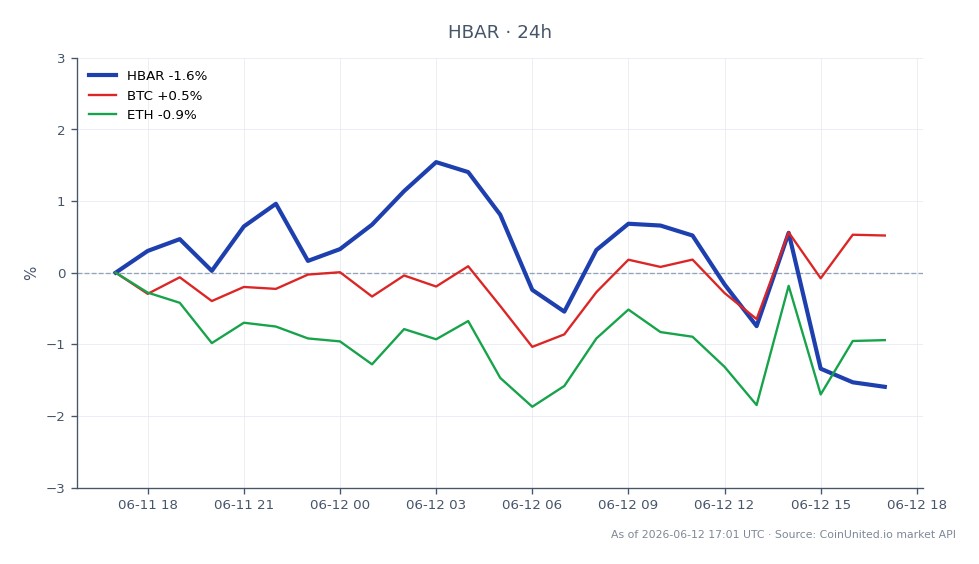
For HBAR specifically, the structural demand channel is real. As HBR AUM grows, the trust staking HBAR at scale could lock up a meaningful portion of circulating supply, modestly tightening float on exchanges — a slow-burn supply dynamic that tends to be constructive for price over time. According to live market data, HBAR is currently trading at $0.0778 (+0.87% over 24 hours), with an intraday high of $0.0805, suggesting the market has not yet priced in a significant re-rating from this filing. The immediate catalyst is muted; the longer-term signal is structural.
For traders watching the broader crypto ETF landscape, the regulatory read-through is the more significant trade. If the SEC does not push back on staking being embedded in registered ETF products, it opens the door for competing issuers to adopt similar or more shareholder-friendly structures — potentially sharing a portion of yield to capture AUM flows. That competitive pressure could compress management fees industry-wide, while simultaneously increasing demand for PoS tokens via regulated channels. Traders tracking crypto funding rates and positioning should monitor whether HBAR open interest builds on this structural tailwind or remains range-bound near current levels.
For leveraged traders, the setup is more event-driven than momentum-driven today. The filing itself is bullish for the medium-term HBAR demand thesis, but immediate price catalysts require confirmation — watch for HBR AUM growth data and any SEC comment letters as leading indicators.
Trade Hedera Hashgraph on CoinUnited.io
Trade HBAR with up to 2000xx leverage → | Create Free Account
Frequently Asked Questions
No. According to the amended Sponsor Agreement, all staking rewards generated by the trust's HBAR accrue entirely to the sponsor, Canary Capital — not to ETF shareholders.
Continue Exploring
Disclaimer: This brief is for educational purposes only and is not investment advice.