Quick Links
SpaceX Lands $2.1T Nasdaq Debut — What the Biggest IPO Ever Means for Leveraged Traders
Data Snapshot
Key Takeaways
- •SpaceX closed its Nasdaq debut at $160.95, realizing a ~$2.1T market cap — surpassing Broadcom and ranking among the largest global public companies.
- •Leverage risk is elevated: constrained float (Musk retains ~42–45%) amplifies intraday swings; 50x CFD traders face liquidation on moves as small as 2%.
- •Index inclusion is a medium-term catalyst — passive funds will be forced buyers, potentially pressuring existing mega-cap constituents on rebalancing.
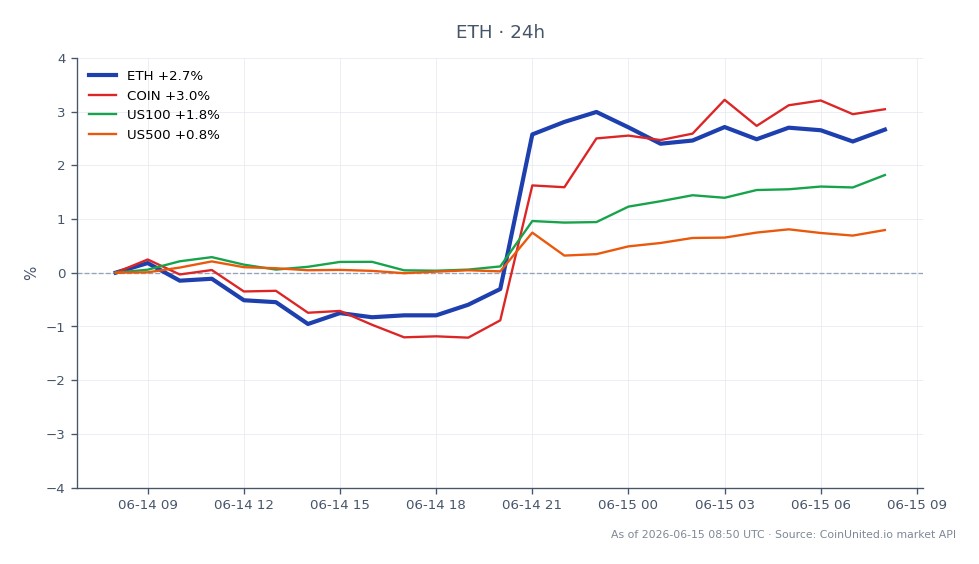
- •Risk-on spillover benefits high-beta proxies: COIN, BTC, and ETH historically correlate with frontier-tech euphoria cycles.
- •SpaceX's successful listing is expected to accelerate the IPO pipeline for OpenAI and Anthropic, reinforcing the broader IPO Wave & Capital Markets Revival theme.
SpaceX (Space Exploration Technologies Corp.) has completed what is being reported as the largest IPO in stock market history, debuting on Nasdaq with shares closing at $160.95 and a realized market c
Event Summary
SpaceX (Space Exploration Technologies Corp.) has completed what is being reported as the largest IPO in stock market history, debuting on Nasdaq with shares closing at $160.95 and a realized market capitalization of approximately $2.1 trillion — surpassing Broadcom and closing in on Amazon, according to post-debut reporting. Pre-deal expectations had penciled in a $1.5–$2.0 trillion range and proceeds of up to $75 billion, making the final outcome at the top end of projections.
Goldman Sachs served as a lead underwriter. Elon Musk is estimated to retain roughly 42–45% of SpaceX, with dual-class control structures preserving his veto power. The three core value drivers cited in IPO coverage: launch services (Falcon/Starship), Starlink satellite internet, and AI-adjacent data infrastructure.
Leverage Impact Analysis
SpaceX CFDs are now live as a mega-cap single-name trade on CoinUnited.io with up to 2000x leverage — and the float dynamics create outsized volatility opportunity and risk.
Worked example (long): A trader opening a 50x long SpaceX CFD at the $160.95 debut close with $1,000 margin controls $50,000 notional (~310 shares equivalent). A 5% move to ~$169 returns +250% on margin. A 2% adverse move to ~$157.73 triggers liquidation at 50x with no buffer.
Key risk — constrained float: With Musk holding ~42–45% and institutional allocations locked up, the effective tradeable float is narrow. Thin float + high retail enthusiasm = amplified intraday swings. At high leverage (100x+), even 1% gap moves become liquidation events. Position sizing discipline is critical on debut-week sessions.
Volatility regime: New mega-cap IPOs typically see 5–15% intraday ranges in the first two weeks. Traders using CoinUnited's SpaceX Pre-IPO synthetic CFD framework should reassess leverage ratios now that price discovery is live rather than synthetic.
For the broader AI & Crypto IPO Launch Wave, this event signals elevated volatility across all recent and upcoming listings.
Cross-Market Impact
US Indices (NASDAQ 100, S&P 500): At $2.1T, SpaceX is a near-certain candidate for major index inclusion. Passive funds will be forced buyers on inclusion date, creating a pre-announcement front-running opportunity. Funding those purchases requires selling existing constituents — watch for relative pressure on current mega-cap tech names.
Crypto (BTC, ETH): No direct on-chain link, but SpaceX's successful debut reinforces risk-on sentiment. In prior cycles, frontier-tech euphoria (Tesla 2020, NVDA 2023) has correlated with crypto upside via shared speculative capital flows. Monitor BTC funding rates for confirmation of sentiment spillover per the 2026 Crypto Market Outlook.
Coinbase (COIN): As a high-beta growth-tech proxy, COIN tends to move with risk-on IPO waves. The IPO Wave & Capital Markets Revival theme directly supports COIN multiple expansion if SpaceX triggers a broader IPO pipeline reopening (OpenAI, Anthropic cited as next candidates — see OpenAI Pre-IPO guide).
Space-adjacent stocks (RKLB): Rocket Lab and peers face a dual read — positive sector attention but potential multiple compression as SpaceX's $2.1T valuation sets a new benchmark that smaller operators cannot match on growth metrics.
Trading Considerations
The $160.95 debut close is the initial price anchor. First-week support will likely form near the IPO offer price band; resistance is open given no prior public trading history. Watch daily volume closely — thin float means large block trades can gap the price significantly. Index inclusion timing (typically 1–3 quarters post-IPO for S&P eligibility) is a medium-term catalyst worth tracking.
The broader AI & Crypto IPO Wave context suggests capital rotation away from established mega-caps into new listings could create short-term dislocations in names like AMZN and NVDA — both worth monitoring for relative-value trades during rebalancing windows.
Start Trading on CoinUnited.io
Create Your Free Account → — Trade crypto, stocks, forex, indices, and commodities with up to 2000x leverage and zero fees.
Frequently Asked Questions
Given the constrained float and expected 5–15% intraday ranges typical of new mega-cap IPOs, keeping leverage at 10x–20x preserves margin buffer against gap moves. At 50x, a 2% adverse move triggers liquidation with no room for recovery.
Continue Exploring
Disclaimer: This brief is for educational purposes only and is not investment advice.