Quick Links
ECB's Kazaks Signals Conditional Readiness: What 'Act Again If Needed' Means for Leveraged EUR/USD Traders
Data Snapshot
Key Takeaways
- •Kazaks is a voting ECB Governing Council member — his comments directly shape rate-path expectations for Euribor futures and EUR crosses.
- •The statement's directional ambiguity is itself the risk: leveraged EUR/USD traders face liquidation exposure in both directions until the hawkish/dovish framing is confirmed.
- •EUR/USD trades at $1.1600; Kazaks has previously flagged ~$1.20 as a potential ECB intervention threshold, creating a structural cap on leveraged long positions.
- •Cross-market: German Bund yields, Gold, and DAX are the primary transmission channels — watch all three for market consensus on whether this is a hawkish or dovish signal.
- •No directional conviction is warranted until the next Eurozone CPI print or ECB meeting commentary clarifies the implied policy bias.
ECB Governing Council member Martins Kazaks — governor of Latvia's central bank and a voting member of the ECB's main policy body — has signalled that the ECB is prepared to adjust policy rates again
Event Summary
ECB Governing Council member Martins Kazaks — governor of Latvia's central bank and a voting member of the ECB's main policy body — has signalled that the ECB is prepared to adjust policy rates again if conditions warrant. According to Bloomberg, Kazaks has consistently advocated a data-dependent, meeting-by-meeting approach, explicitly warning that a "big and rapid" strengthening of the euro could itself trigger a policy response.
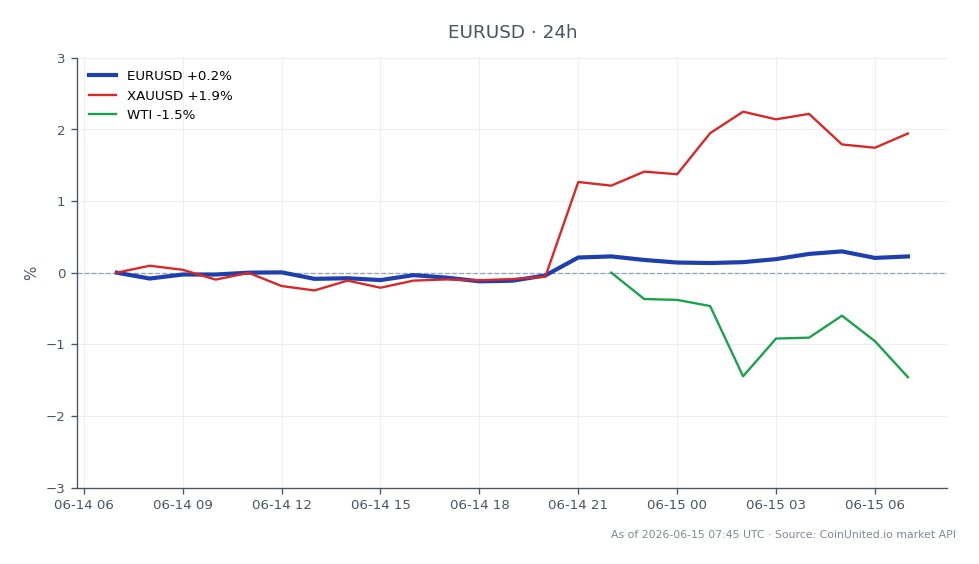
The statement is deliberately ambiguous on direction. As reported by Bloomberg, Kazaks has previously argued against over-reacting to minor inflation deviations while maintaining that the ECB must be ready to move in either direction. With EUR/USD currently trading at $1.16 — flat on the day (-0.05%) — markets are parsing whether this signals residual hawkishness (readiness to hike if inflation resurges) or a dovish backstop (readiness to cut if growth disappoints).
Leverage Impact Analysis
The ambiguity in Kazaks' statement creates asymmetric risk for leveraged EUR/USD positions — and that ambiguity is itself the volatility catalyst.
Long EUR/USD scenario: A trader holding a 100x long EUR/USD position entered at $1.1600 controls a notional $116,000 per standard lot. Each 10-pip move equals approximately $100 in P&L. If the market interprets Kazaks as implicitly hawkish (ECB willing to hike again), EUR could push toward $1.1650–$1.1700. That 50-pip move yields +$500 on a 100x position — but the reverse is equally true. A dovish read pushing EUR/USD down 50 pips to $1.1550 triggers the same loss.
Key liquidation risk: Kazaks has flagged EUR/USD ~$1.20 as a potential ECB intervention threshold. This means significant upside for longs is capped by the ECB's own reaction function — a structural ceiling that leveraged bulls must price in. Conversely, if the remark is read as a cut signal, shorts face a squeeze if EUR rebounds sharply from current levels. With Fed & ECB Policy Divergence Repricing still the dominant macro theme, volatility windows around upcoming ECB meetings warrant tighter stop placement. Monitor open interest on EUR/USD perpetuals for confirmation signals before sizing up.
Cross-Market Impact
The directional ambiguity in Kazaks' comments ripples across multiple asset classes tied to the macro inflation pressure narrative:
- -Gold (XAU/USD): A hawkish ECB read strengthens EUR, which typically pressures DXY — gold-positive. Dovish read reverses this. The gold vs. US dollar inverse relationship makes gold a useful hedge against ECB policy uncertainty.
- -Germany 10-Year Yield: Bunds are the most direct transmission channel. Hawkish interpretation → higher German yields, front-end flattening. Dovish → yields fall, steepening at the long end.
- -WTI Crude Oil: ECB policy affects Eurozone demand expectations. A cut signal could support risk assets and oil; a hike signal weighs on growth and energy demand.
- -Bitcoin: BTC trades as a high-beta liquidity proxy. ECB hawkishness tightening financial conditions = mild risk-off headwind. The effect is indirect but non-trivial during liquidity-sensitive sessions.
- -European equities (DAX, EURO STOXX 50): Export-heavy sectors (autos, industrials) benefit if Kazaks' FX sensitivity comment caps EUR upside. Rate-sensitive sectors face pressure under any hawkish re-pricing tied to Fed & ECB rate patience macro repricing.
Trading Considerations
EUR/USD is trading at $1.1600 with a compressed daily range (24h high = 24h low per live data), suggesting the market has not yet committed to a directional read on Kazaks' remarks. The key level to watch is $1.1550 (near-term support) and $1.1650–$1.1700 (resistance zone before the ECB's self-identified sensitivity band near $1.20). For the full EUR/USD setup and key technical levels, CoinUnited's asset deep-dive provides context.
The primary risk factor is misreading the hawkish/dovish framing: watch Eurozone CPI prints, upcoming ECB meeting dates, and any follow-on remarks from other Governing Council members for directional confirmation before adding leverage.
Trade Euro / US Dollar on CoinUnited.io
Trade EURUSD with up to 2000xx leverage → | Create Free Account
Frequently Asked Questions
A 100x long EUR/USD at $1.1600 faces roughly $100 P&L per 10-pip move — the ambiguity in Kazaks' directional signal means both a 50-pip rally and a 50-pip selloff are plausible, so tight stops are essential until the hawkish/dovish read is confirmed by data or follow-on ECB commentary.
Continue Exploring
Disclaimer: This brief is for educational purposes only and is not investment advice.