Quick Links
Bitcoin at $65,686 on Iran-Hormuz Headlines — Warsh's Fed Debut Is the Rally's Real Test
Data Snapshot
Key Takeaways
- •BTC is trading at $65,686 (+1.71%), rallying on Trump's Iran-Hormuz deal claim — but Iran disputes the Sunday timeline, making the entire move headline-dependent.
- •Leveraged long positions above 50x entered near $64,900 face liquidation risk if a deal collapse drives BTC back toward $63,400.
- •A confirmed deal would compress WTI's war-risk premium, ease inflation expectations, and create a multi-asset risk-on wave benefiting crypto, equities, and weakening the yen.
- •The Fed angle (Warsh leadership) is a secondary but real risk — any hawkish repricing could neutralize the Iran-driven relief rally.
- •Crypto-proxy equities (MSTR, MARA, RIOT, COIN) amplify BTC's directional move — both to the upside on confirmation and to the downside on deal collapse.
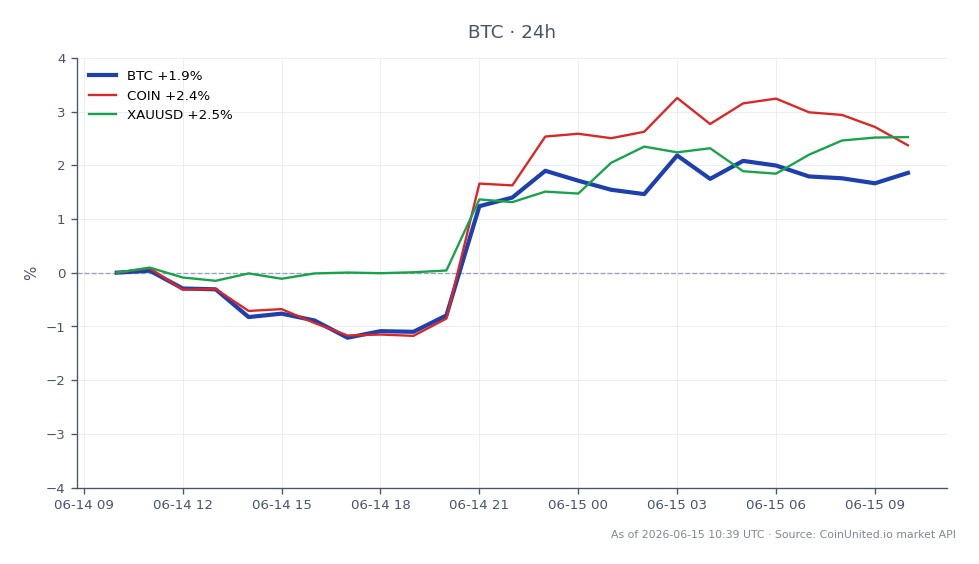
As reported by CoinTelegraph and crypto.news, U.S. President Donald Trump stated that a U.S.-Iran deal could be signed Sunday and that the Strait of Hormuz would be open to all traffic afterward. Bitc
Event Summary
As reported by CoinTelegraph and crypto.news, U.S. President Donald Trump stated that a U.S.-Iran deal could be signed Sunday and that the Strait of Hormuz would be open to all traffic afterward. Bitcoin reacted immediately, rallying to a 24-hour high of $65,993.30 — currently trading at $65,686, up +1.71% on the day. However, Iran publicly disputed the Sunday signing timeline, keeping event risk squarely on the table. The move is headline-driven, not yet fundamental.
The secondary overhang is the Federal Reserve. With Kevin Warsh widely discussed as a potential incoming Fed figure, traders are watching whether any policy signals emerge that could alter the liquidity backdrop underpinning this risk-on move. As covered in our Fed Macro Policy Crossroads theme, any hawkish repricing would directly blunt the Iran-driven relief rally.
Leverage Impact Analysis
BTC's 24h range of $64,918–$65,993 represents approximately $1,075 of realized volatility. For leveraged perpetual traders, this is high-consequence territory.
Worked example — long: A trader entering a 50x long BTC perpetual at $64,920 (daily low) with a $1,000 margin controls $64,920 in notional exposure. At current price $65,686, that position shows a ~$766 unrealized gain (+76.6% on margin). However, if Iran's denial triggers a reversal to $63,500, the same position faces a ~$71,000 notional drawdown per BTC — translating to a ~$1,420 loss on $1,000 margin, triggering liquidation.
Short squeeze risk: The Iran-headline pop from ~$64,000 to $65,993 likely triggered cascading liquidations on short positions carrying >30x leverage. Traders who held short positions anticipating deal failure near $64,000 would have seen liquidation triggers fire before any confirmation from Tehran. Monitor crypto funding rates — if rates turn sharply positive, late longs are paying heavily and a fade becomes the higher-probability trade.
Given Iran's denial keeps the event unconfirmed, high-leverage longs (>50x) face binary risk: deal confirmation could push BTC toward $68,000+; a full reversal on collapsed talks could revisit $62,000–$63,000 quickly. Position sizing must reflect this headline dependency.
Cross-Market Impact
This is a classic Iran de-escalation energy trade pivot setup across asset classes. A confirmed Hormuz reopening would compress the war-risk premium in WTI crude, reducing energy-driven inflation expectations and easing pressure on Treasury yields — a net positive for risk assets including equities and crypto.
For equity proxies: MSTR, COIN, MARA, and RIOT benefit directly from BTC's upside but carry amplified downside if the deal falls through. The FOMC inflation policy crossroads means softer oil could give the Fed room to stay on hold rather than hike — a mild tailwind for risk assets. Gold typically softens on genuine de-escalation as safe-haven demand fades. The US Dollar / Japanese Yen pair warrants attention: a risk-on environment tends to push USD/JPY higher as yen safe-haven bids unwind.
Asia equities have already rallied on the headline, per YouTube-sourced market commentary, signaling early cross-regional confirmation — but without deal ratification, the move remains fragile.
Trading Considerations
Key levels: BTC support sits at the 24h low of $64,918; below that, $63,400 (per bitcoin.com reporting on prior Iran-denial price) is the next structural level. Resistance is the 24h high at $65,993 — a confirmed close above this opens the $67,000–$68,000 range. The bitcoin geopolitical payment rails thesis gains credibility on sustained de-escalation, but requires deal confirmation from both parties.
Watch for: (1) official statement from Tehran or U.S. State Department confirming deal terms; (2) ETF flow data as a sentiment proxy; (3) any Fed-related commentary from Warsh that reprices rate-cut expectations. Until confirmation, treat this as a high-volatility, headline-sensitive environment — not a trend trade.
Trade Bitcoin on CoinUnited.io
Trade BTC with up to 2000xx leverage → | Create Free Account
Frequently Asked Questions
Given the $1,075 24h range and binary headline risk, positions above 20x should use hard stop-losses near $64,900 (the day's low). At 50x, a $1,500 adverse move from entry would wipe out a standard margin deposit.
Continue Exploring
Disclaimer: This brief is for educational purposes only and is not investment advice.