Quick Links
Iran Deal Rally Hits Gold & Silver — But Rate Hike Headwinds Create Two-Sided Leverage Risk
Data Snapshot
Key Takeaways
- •Leveraged metals positions face two-sided risk: the Iran deal rally and partial reversal created a $137 intraday gold range — at 200x+ leverage, even a $1 adverse move is material against margin buffers.
- •Silver currently trades at $70.75 (+2.05%), with the 24h range of $69.51–$71.32 defining near-term support and resistance for CFD traders.
- •Oil prices plunged on Strait of Hormuz reopening news — this disinflationary signal could soften Fed tightening expectations and provide a secondary tailwind for gold via lower real yields.
- •Cross-market: USD weakened and equities rallied in a broad risk-on response; energy producers face headwinds while airlines and industrials benefit from lower fuel costs.
- •Deal confirmation risk is the dominant variable — if the draft agreement is not signed ahead of the G7 (June 15–17), geopolitical premium could unwind sharply, triggering liquidation cascades in leveraged metals longs.
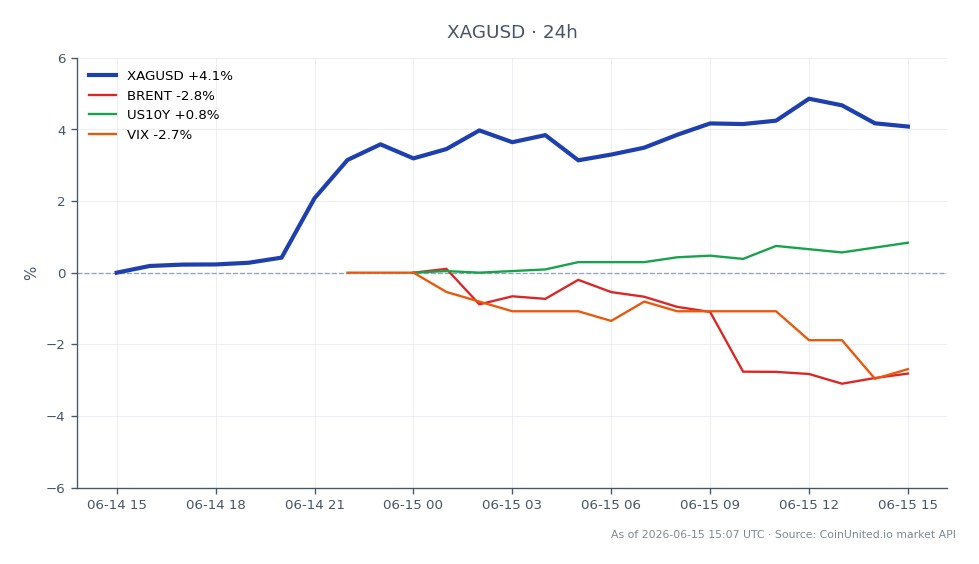
According to multiple market reports including Kitco and goldsilver.com, a reported U.S.-Iran ceasefire agreement triggered sharp moves across precious metals, energy, and FX markets. Iranian state me
Event Summary
According to multiple market reports including Kitco and goldsilver.com, a reported U.S.-Iran ceasefire agreement triggered sharp moves across precious metals, energy, and FX markets. Iranian state media published a 14-point draft agreement, with Bloomberg reporting a possible signing as soon as Sunday in Switzerland — ahead of the G7 summit running June 15–17 in Evian, France. Key draft terms reportedly include reopening the Strait of Hormuz within 30 days, U.S. lifting of oil sanctions, unfreezing of Iranian funds, and a reconstruction package of at least $300 billion.
Market reaction was immediate but mixed. As reported by investing.com, spot gold touched $4,856.00/oz before pulling back to $4,719.35/oz, with June gold futures settling at $4,745.15/oz. Silver, per live market data, currently trades at $70.75, up +2.05% on the session (24h high: $71.32; low: $69.51). As noted by Heraeus via Kitco, rate-hike expectations remain a structural headwind for both metals despite the geopolitical tailwind.
Leverage Impact Analysis
The Iran deal creates a two-sided leverage trap for precious metals traders. The initial risk-off unwind pushed gold and silver sharply higher, then partially reversed — a classic stop-hunt pattern that punishes both leveraged longs and shorts.
Worked example — Silver CFD long: A trader opening a 50x long Silver/USD position at the session low of $69.51 who held through the current price of $70.75 captures a $1.24/oz move. At 50x, that translates to a ~1.78% gain on margin. However, the same position opened near the 24h high of $71.32 faces an unrealized loss of -$0.57/oz — roughly a -0.8% drawdown at 50x, already meaningful against tighter margin buffers.
Liquidation risk: At higher leverage (200x+), a $1.00 adverse move from entry is sufficient to approach margin thresholds. Given gold's intraday swing from $4,856 to $4,719 — a $137 range — leveraged gold longs opened near the session peak face significant drawdown risk if the deal's implementation is delayed or denied.
Funding rate dynamics also warrant monitoring. Rapid long-side accumulation driven by geopolitical headlines often precedes funding rate spikes on perpetual contracts. Check live funding rates on CoinUnited.io before adding to existing positions.
Cross-Market Impact
The Iran de-escalation energy trade pivot radiates across five asset classes simultaneously:
- -Oil: The Strait of Hormuz reopening narrative drove crude prices sharply lower, stripping the geopolitical risk premium from Brent crude and WTI. Lower energy costs are broadly disinflationary — read our Hormuz Strait & Energy Markets guide for structural context.
- -USD & Rates: As reported by goldsilver.com, the U.S. dollar weakened in the initial reaction, mechanically supporting metals via the gold-dollar inverse relationship. The U.S. 10-year yield eased as lower oil reduced near-term inflation expectations, softening Fed tightening odds — directly relevant to the Fed macro policy crossroads theme.
- -Equities: Broad risk-on lifted equity index futures. Airlines, industrials, and transports are likely near-term beneficiaries via lower fuel costs. Energy producers face the reverse.
- -VIX: A compression in geopolitical risk premium should suppress implied volatility — favorable for short-vol strategies but a warning sign that complacency can reverse fast if deal talks stall.
The macro inflation pressure dynamic cuts both ways: lower oil eases CPI, but if the Fed interprets this as room to hike, real yields could rise and re-pressure gold.
Trading Considerations
For silver, the current price of $70.75 sits between the 24h low ($69.51) and high ($71.32), offering a defined near-term range. A sustained break above $71.32 with volume confirmation would suggest the geopolitical bid is holding; a failure below $69.51 signals the rate-hike headwind is dominating. For gold, the $4,719–$4,856 intraday range defines the immediate battleground — watch whether price can reclaim $4,800 to confirm bull continuation.
The key risk is deal confirmation. If the 14-point draft does not advance to a signed agreement before the G7 summit, the geopolitical premium that drove this rally could flush rapidly, creating cascading liquidations in leveraged metals longs — as seen in the prior US-Iran optimism episode covered in our recent pulse on gold two-month lows.
Trade Silver / US Dollar on CoinUnited.io
Trade XAGUSD with up to 1000xx leverage → | Create Free Account
Frequently Asked Questions
Silver's $1.81 intraday range ($69.51–$71.32) means a 100x leveraged position can swing ~2.6% on margin from trough to peak — positions opened near session highs face immediate drawdown risk if deal optimism fades. Monitor live funding rates and set stops outside the session range to avoid noise-driven liquidation.
Continue Exploring
Disclaimer: This brief is for educational purposes only and is not investment advice.